
Portfolio Update
Tech stocks are struggling and portfolios are down, but we aren't worried...


Rivo puts the cash sitting in your bank account to work, so your money earns automatically. You don’t have to switch banks or move money manually.
You have money sitting in your bank account that could be earning. But moving it around is a hassle. Rivo automatically moves the cash you are not using into U.S. government-backed assets and brings it back before your bills are due. Set it up once, and let Rivo do the work. Try Rivo for free now.
Everybody, welcome back to another portfolio update for The Simple Side. We are going to quickly jump into what we are seeing in the markets, talk about how to keep emotion out of what is happening right now, explain why this is not generation-defining, and then walk through our portfolios. Let’s get into it.
Welcome to The Simple Side. Market-beating picks inside. There is no jargon and no time to waste. Join The Simple Side and end up in first place.
Like always, I just wanted to thank you for being here and supporting The Simple Side as we talk about investing, our investments, and how to keep emotions out of the investing field. It is so important to do this, and at the same time, it is extremely hard, which is why retail investors who are trying to do their own trading often end up underperforming the market.
Of course, it happens to almost everyone who is just getting into the market, getting excited, and paying attention to the media. What we are trying to do is set standards for ourselves and follow those standards without getting too upset, happy, mad, or sad about our investment decisions.
So we are going to talk about that today. I am going to give you some data so you can understand what is happening, because when you understand why something is happening, it helps you remain less emotional about it. If you do not understand what is going on, that is when you start to get excited, upset, and reactionary.
Quick update on the current macro environment!
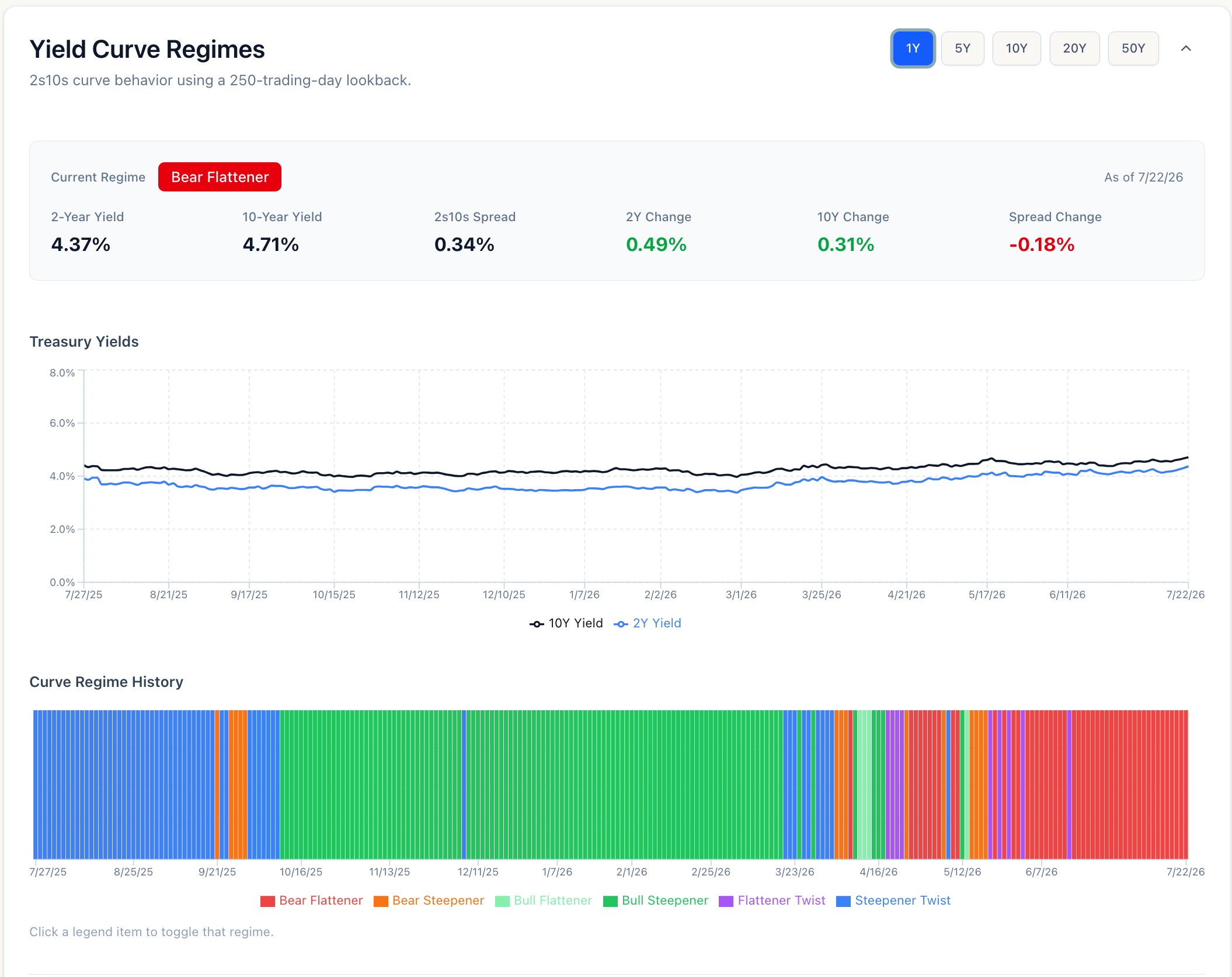
The first thing we always talk about is the simple, normal, but still proprietary data I have been using to build this macro regime tracker.
We look at 2-year yields, 10-year yields, the spread between the 2-year and 10-year, the 2-year change, the 10-year change, and the current spread change. This has been updated as of the 22nd. Thursday or Friday was the last time we really updated it, but I believe the graph on the website is currently showing data through the 22nd, so it stays relatively up to date.
Basically, what we are seeing is that there is still a gap between short-term and long-term yields, but that gap is shrinking. In the chart, if you go look at the newsletter, which is available at thesimpleside.substack.com, you can see that the 2-year yield is rising. It is up about 0.49 percentage points, while the 10-year is rising by 0.31 percentage points. That is cutting the spread, which means the spread is decreasing. That is where you see the spread change at -0.18%.
A simple way to think about this is that traders are currently pricing in tighter Federal Reserve policy for longer. There is less faith that long-run economic growth is going to continue rising at the current pace, or at an even higher pace. Traders are not expecting long-term growth to continue at the rate it has recently been moving.
That being said, the curve is still above zero, so it is not an inversion by any means. But it does warn that credit is getting more expensive and growth may be losing speed at the same time. Treasury yields also continue climbing, with the 2-year yield at 4.33% and the 10-year yield at 4.69% as of around July 22nd to July 24th.
Economic Backdrop
With that being said, the economy is still growing, though the numbers are no longer particularly bullish. Real GDP rose at about a 2.1% annual rate during Q1. Of course, that was helped by all of the AI investment, along with exports and government spending.
The labor market has cooled more clearly. Employers added only 57,000 jobs in June, while unemployment is holding around 4%. That is definitely not recession-looking data, but it is also not glorious growth either.
In my opinion, that leaves less room for another big shock to the system. I think it is a place where you could start allocating some capital and feel relatively safe that things are not going to get flipped on their head anytime soon.
Policy rates for the Fed are currently around 3.50% to 3.75%. Inflation is still above the 2% target, so there is no surprise there.
Oil Shock and Market Pressure
One of the factors driving all of this is the oil shock, which ties into the economy and the yield curve. The war involving Iran has restricted shipping in a major way, created significant restrictions on oil, and damaged energy facilities and their ability to push cheap energy through their pipelines.
Gas prices are running above $4 per gallon for some people, and maybe closer to the $3.80 range for others. Crude oil finished Friday below $97, or maybe below $100, but it is still very elevated compared with the $60 range we were experiencing before the war.
Oil is up about 30% throughout July. The war in Iran was supposedly “done,” but if you watched traffic, it was not really done. Now, of course, we are watching oil run back up as Iran starts saying publicly, “Hey, this is not done yet.” Talks will continue, and Trump will do his thing to try to keep prices down, but shipping is still disrupted. Attacks have spread to Saudi oil in the Red Sea, and major routes running through the Gulf are still strained.
The problems are still happening, and they are not going anywhere anytime soon. That will probably keep the market depressed. But like I said earlier, you have to ask whether this is a generation-defining event that will change the way businesses operate, or whether it is Mr. Market mispricing assets. I think the latter is more accurate.
Of course, consumers are going to pay more at the pump. Airlines, trucking, and related industries will be hit pretty hard. Railroads may start doing better because they are cheaper than trucking, and more product may move across the U.S. by rail. We have seen that with companies such as Norfolk Southern (NSC).
Consumers are hurting a little bit and have less cash for purchases, but there is still a lot of money floating around in businesses. So there is nothing to be violently worried about.
Who Gets Hurt and Who Benefits
At the end of the day, weak hiring, expensive credit, oil-driven inflation, and higher short-term yields hurt banks that have to pay more for deposits and funding.
Higher yields hurt the yield curve and indebted businesses the most. Profits have been rising for many years now, but with borrowing getting more expensive, heavily indebted companies are going to struggle. We have seen that with companies like Oracle (ORCL), which has been getting crushed recently.
Energy services firms should be doing well here, but it seems like they have been struggling over the past few months. That is something we may need to dive deeper into.
Given the current state of things, I would not treat this as a generation-defining event. If you are looking for investments in transportation, airlines, trucking, and similar sectors, this is probably a good time to take your pick of the litter. If you are looking for dividend picks or long-term holds and want to go into those sectors, it is a good time to take a peek.
Flagship Fund
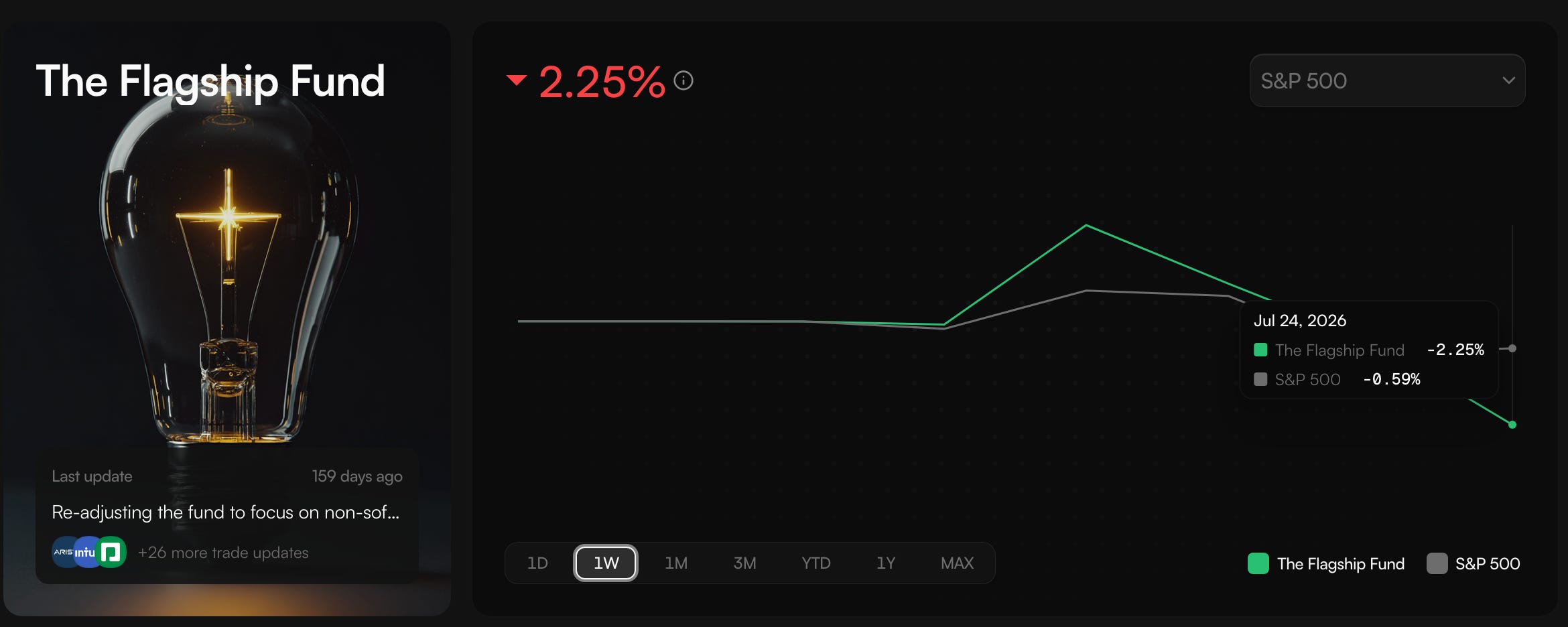
Portfolio Impact: Flagship Fund
I think our flagship fund is facing the most direct risk. ASML (ASML), Applied Materials (AMAT), Lam Research (LRCX), KLA (KLAC), and Monolithic Power Systems (MPWR) are some of the largest holdings in the fund, along with Alphabet (GOOGL), Meta Platforms (META), and Arista Networks (ANET).
That being said, I do not know if these businesses really need “cheap debt” right now. A lot of their stock prices depend on earnings growth, and many of them are growing very quickly year over year.
As I mentioned with the growth stocks, Treasury bonds near 5% give investors a higher hurdle. They now have to weigh a 5% no-risk return against what the market can offer at extended high P/E ratios on companies we are betting on for future growth, when they can lock in that 5% return. That is difficult.
AI Second Hand Effects
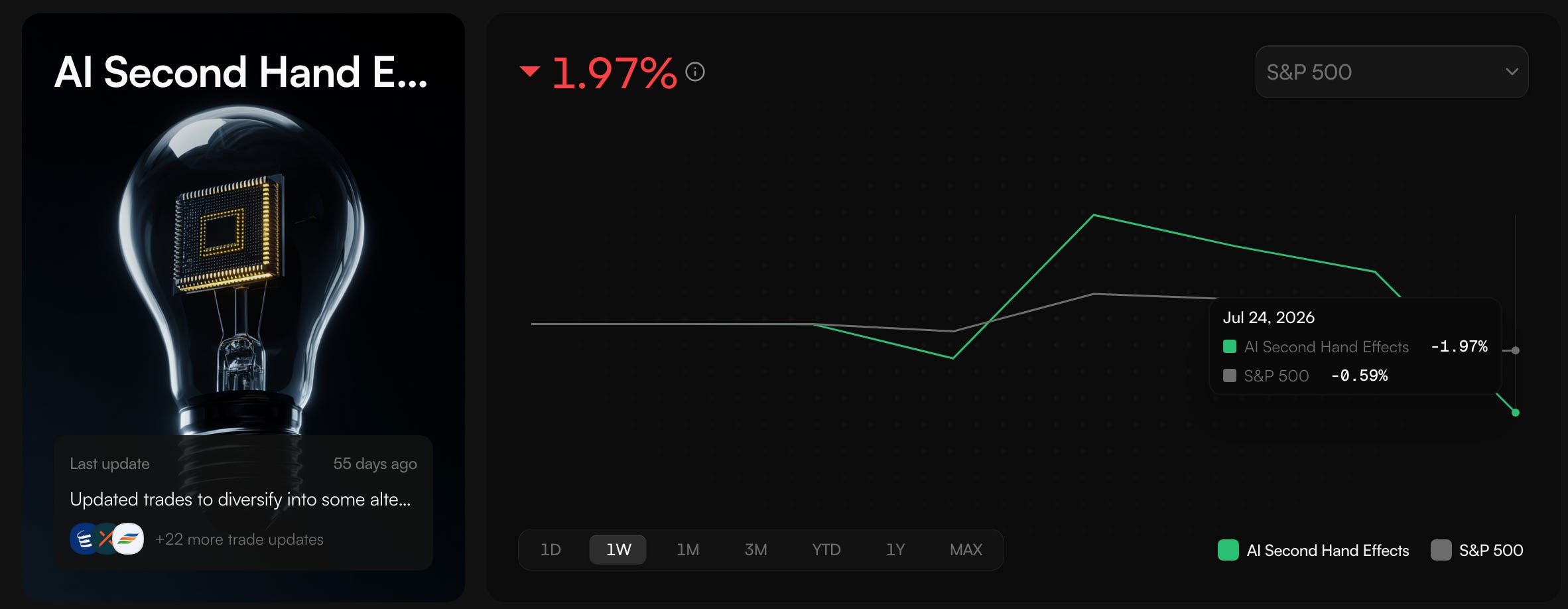
Portfolio Impact: AI Secondhand Effects
I think the AI Secondhand Effects Portfolio is really the best fit for this setup. GE Vernova (GEV), Fluor (FLR), Baker Hughes (BKR), BWX Technologies (BWXT), Cameco (CCJ), Uranium Energy (UEC), and the Global X Uranium ETF (URA) are all tied to power generation, oil and gas, nuclear fuel, and large construction projects.
Energy Transfer (ET) and Baker Hughes (BKR) could benefit from greater spending on production, pipelines, and exports.
Some of the others, like Cameco (CCJ), Uranium Energy (UEC), BWX Technologies (BWXT), and uranium-related exposure through URA, have the possibility to gain from countries trying to rely less on oil now that it is getting expensive and now that they know they have to ship it through unstable regions.
GE Vernova (GEV) could benefit from more spending on grids, turbines, power equipment, and similar infrastructure. Building out nuclear facilities could also be a potential boost.
Companies like Fluor (FLR) and MasTec (MTZ) could see more work, even though expensive financing may delay customer projects. All of those companies are worth paying attention to.
Bloom Energy (BE) and Ormat Technologies (ORA) are also worth watching. Bloom is essentially a power supplier for companies that cannot get plugged into the grid, while Ormat is the geothermal energy play. That helps with power scarcity and power on demand. If borrowing costs eventually come down, that should help companies that cannot get connected to the grid.
Tech Growth
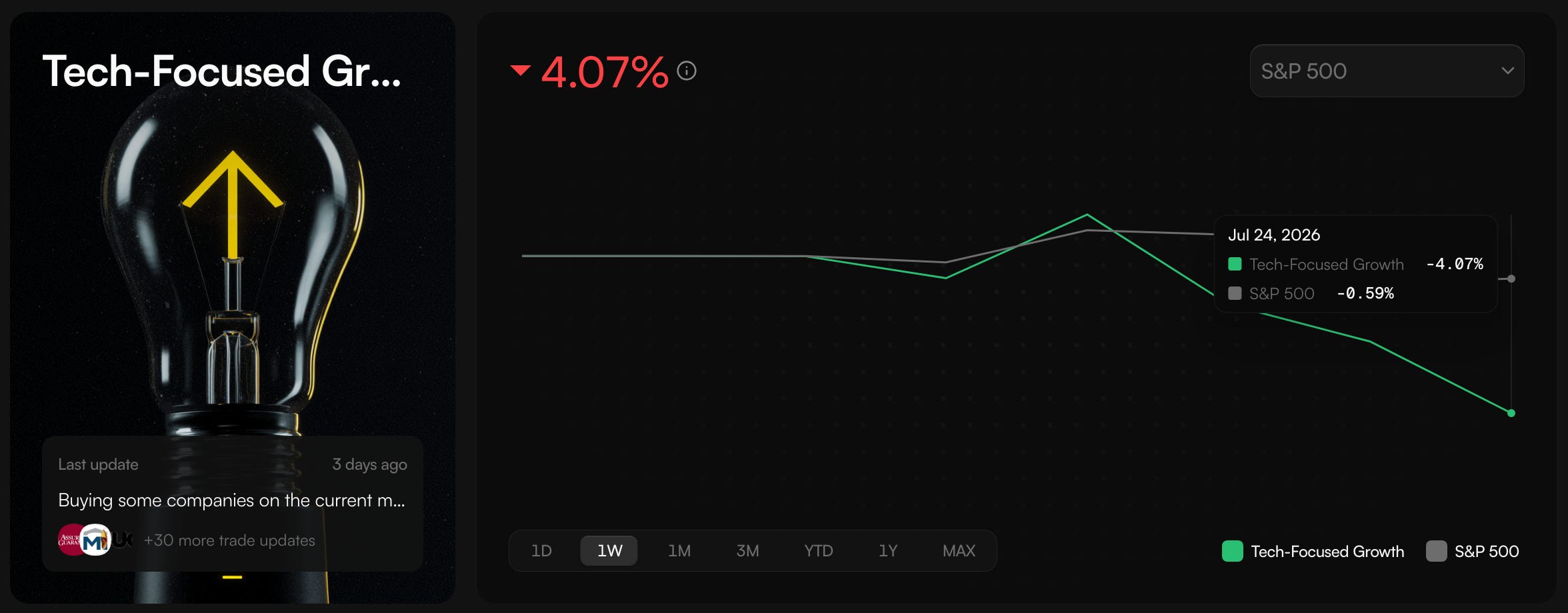
Portfolio Impact: Tech Growth
In the Tech Growth Portfolio, this is mostly a financial-looking portfolio at the current moment. We have a lot of insurance plays, including Reinsurance Group of America (RGA), Arch Capital Group (ACGL), and Assured Guaranty (AGO). These companies should be able to earn more on the bonds they purchase.
Insurance companies have to make money with the capital sent to them, and a lot of that money goes into bonds and other safer assets. With higher yields, they should be making more money.
Banks like KB Financial (KB), First Citizens BancShares (FCNCA), and Western Alliance Bancorporation (WAL) are going to earn more on loans. They will also pay more on deposits, but what they earn on loans should be much more than what they pay on deposits. They are also getting a lot of loans, especially for AI build-out, data centers, and similar projects.
On the other hand, buyers are being priced out. New mortgages at higher rates are slowing activity. Companies like NMI Holdings (NMIH) could potentially slow down because of that. Other companies like MGIC Investment (MTG) may also face this kind of reckoning.
We are looking at potentially getting rid of some of those holdings or phasing out of them. There was a lot of momentum in those stocks, and we liked them, but as the month comes to an end and we are only four days away from a new month, we will look at transitioning some of those plays.
There is also a lot of stock-price risk in many of the companies we own in this portfolio, and we are feeling that. Zeta Global (ZETA), Ouster (OUST), Ciena (CIEN), and Credo Technology Group (CRDO) carry a lot of those risks.
Since they are growth stocks, and since the economy is rough while Treasuries are paying more, people are going to rotate from growth into Treasuries. Or really, they will rotate from growth funds into more flagship or stable funds, and those flagship and stable funds will rotate down into the Treasury market. They will diversify away from risk.
Perplexity
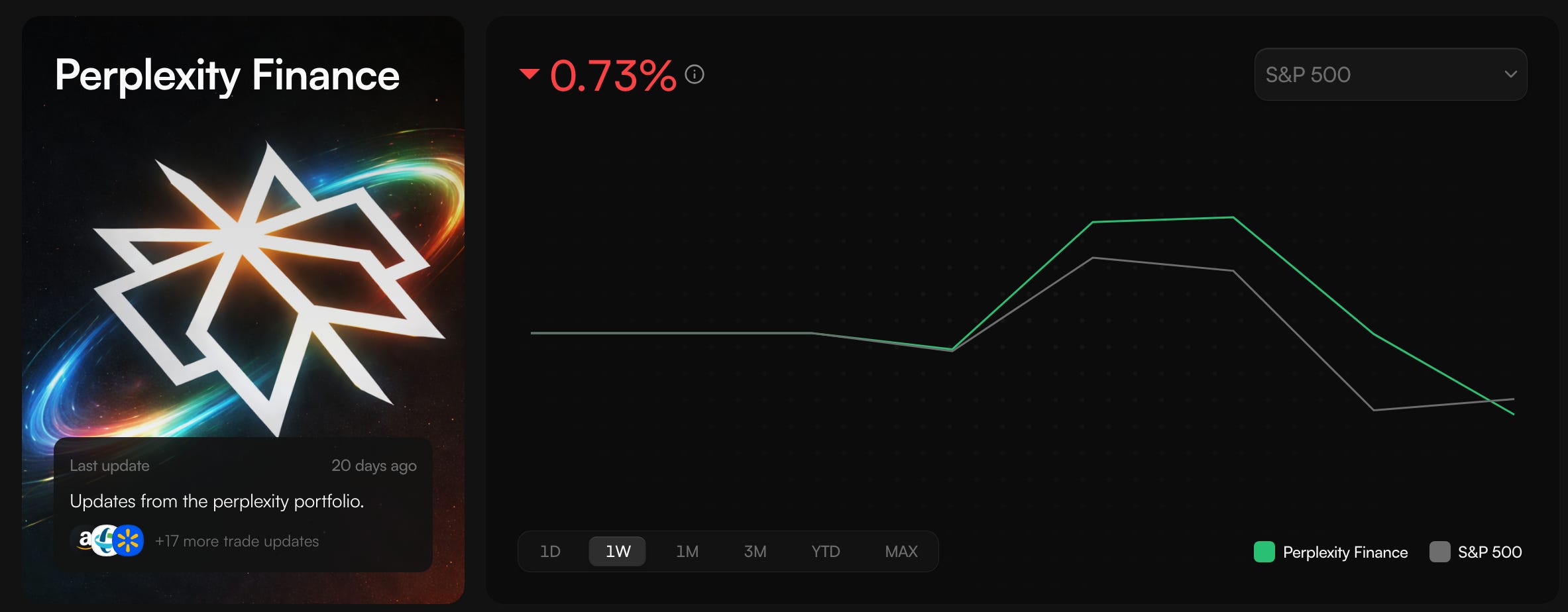
At the moment, this is the broadest mixed portfolio we offer. It holds Micron Technology (MU) and Alphabet (GOOGL), while also carrying Duke Energy (DUK), Walmart (WMT), Costco (COST), PepsiCo (PEP), UnitedHealth Group (UNH), Johnson & Johnson (JNJ), and large exposure to the utilities sector through the Utilities Select Sector SPDR Fund (XLU).
Perplexity Finance is buying XLU in this portfolio, and we are offering that exposure to you. The Perplexity portfolio is much more spread out, and we are seeing that in the performance as well. Whether that performance continues to outperform without heavier allocations into specific areas, only time will tell.
InsiderEdges.com
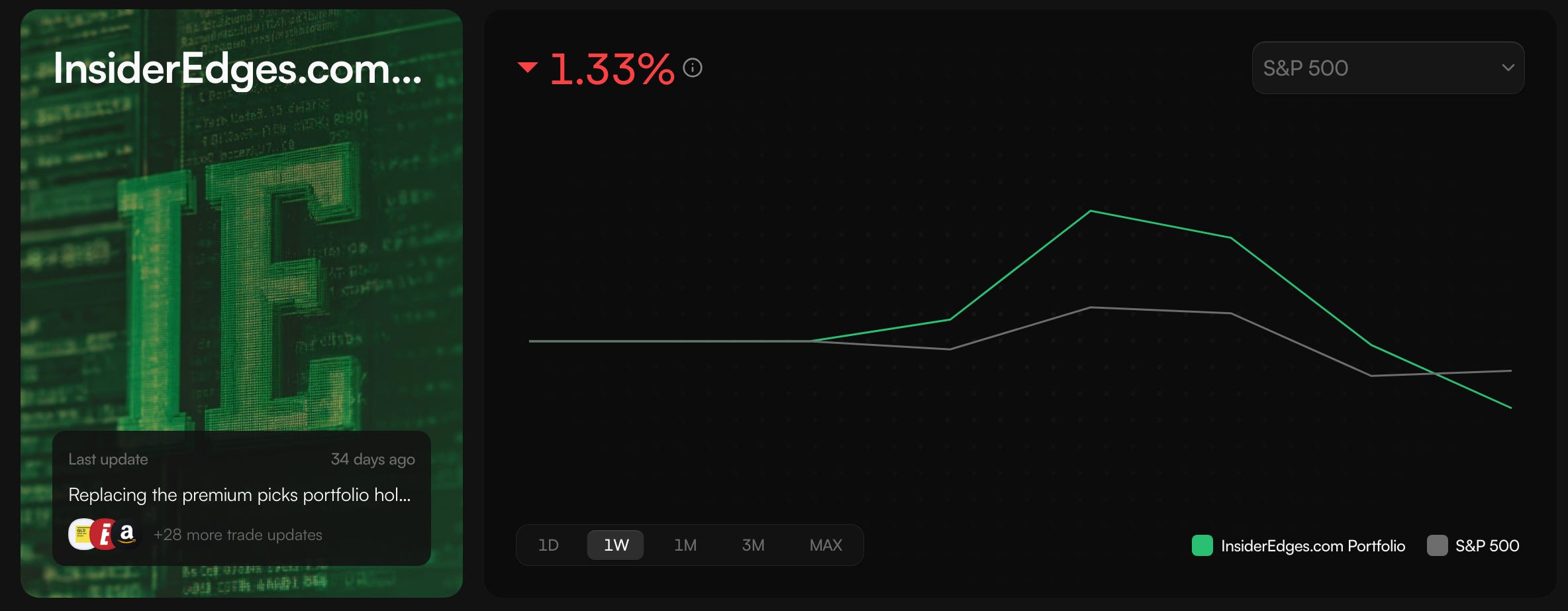
Portfolio Impact: InsiderEdges.com and Perplexity
We will see similar effects in the AI Secondhand Effects Portfolio, and we already have. That portfolio has been declining for a while as the market becomes riskier and investors shift toward safer places.
The InsiderEdges.com portfolio is somewhat outside of my control because it is based on the metrics from the Insider Edges team. Micron Technology (MU), Taiwan Semiconductor Manufacturing Company (TSM), Nvidia (NVDA), and Microsoft (MSFT) all face the same basic story as the flagship fund. They are very sensitive to tech spending and stock multiples.
Then, of course, you have companies like Microsoft (MSFT), Alphabet (GOOGL), and Apple (AAPL). They have large cash balances, but they are spending a lot on the AI build-out. There are major costs there.
At the same time, we are seeing companies like Deere & Company (DE) perform very well, which is no surprise because it can act as a backstop play when the market becomes riskier.
The same is true with banks such as Wells Fargo (WFC) and U.S. Bancorp (USB). Higher loan rates and weaker credit demand create a lot of push and pull, but it seems like the banks are faring fairly well.
Closing Thoughts
In general, I like the way we are positioned across these portfolios. I said it earlier, and I will say it again: I do not think what is happening right now is generation-defining for the market.
I do not see the market declining in a broad, structural way. I think the tech sector, where we are heavily invested across these portfolios, is getting hammered, and we are experiencing that. But overall, I do not think this will change the investing landscape or the way most investors behave.
I think we will be positioned later on to capitalize. We still hold a lot of cash, and we are ready to allocate it. We will probably start buying into many of these companies at the beginning of the week. We may also turn on some auto investments and DCAs as it looks like things are starting to crater a little bit and then climb.
As I mentioned earlier, oil is sitting around $100 per barrel. It could move up to $120 or $150, but that may mean we are getting close to the lowest part of the curve. When things start to come back, we will be happy to allocate money to our portfolios and hopefully recoup a lot of the gains we have lost over the past couple of weeks.
That is all I have for you this week. It is a longer podcast than normal and a longer newsletter than normal, but we wanted to make sure we gave a deep analysis of what we see happening right now. Again, you should not be stressed or worried. At least, we are not stressed or worried about the current market.
I have said it so many times that I sound like a broken record, but I will say it again: these changes are not generation-defining. I am not worried about losing vast amounts of money. That being said, things are expensive, and we do have a lot of cash on the sidelines, which is another reason I can remain calm in this situation.
Remember, stay calm. Email me if you have any questions or want to ask me anything in particular, and I will see you all next week. See you then.

- ¢, Founder of The Simple Side